Short on time? Here are two main takeaways from this article:
Which vessel type is most suitable for nuclear retrofit?
To better understand the opportunities and challenges of nuclear retrofits, Henrik Høidal, system architect at Ulstein, carried out a concept study based on a simple question:
How could an existing diesel-mechanical vessel be converted to nuclear propulsion using technology available today?
The study focused on the technical requirements, vessel modifications and operational implications of such a conversion, assuming that future regulations and approvals are in place.
Step one was to choose a vessel type and operational profile to review, as we can agree that a nuclear retrofit would not suit every vessel. A strong candidate would likely have high annual fuel consumption, long periods of predictable power demand and sufficient remaining service life. For vessels with low daily fuel use or highly dynamic operations, the investment may be harder to justify.
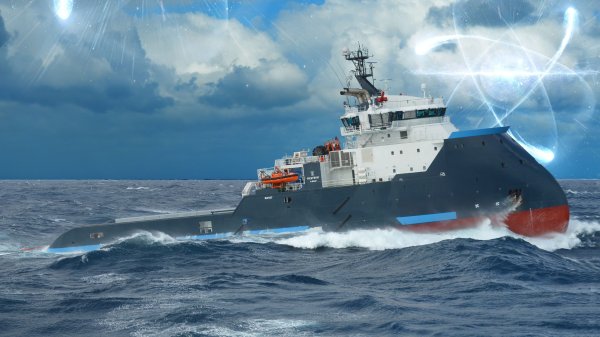
After considering different vessel types and operational profiles, Høidal decided to base the research around the ULSTEIN SX157 long-distance towing design.
Long-distance towing can involve weeks, or even months, of continuous operation and high fuel consumption. The table below is an example of a 30-day towing campaign. If the vessel is to run at 45% propulsion capacity, it consumes nearly 50 m3 of fuel per day. And close to 70 m3 at 65% power. These are significant figures, resulting in high emissions and fuel costs.
The numbers in this example are estimated and specific to towing operations. The operational profile of long-distance towing vessels usually involves longer periods of less fuel-intensive operations, such as transit, stationary on the field, and ashore.
| Example (30-day towing campaign) | m3/day | m3/duration |
|---|---|---|
| Towing at 45% prop. MCR | 47.87 | 1436.1 |
| Towing at 65% prop. MCR | 68.65 | 2059.5 |
47.87
1436.1
68.65
2059.5
The solution
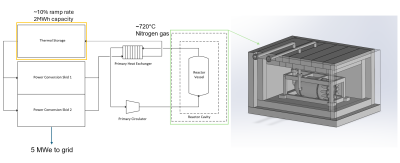
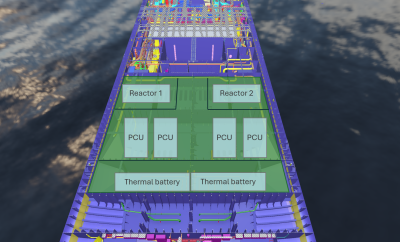
Høidal's study indicates that a nuclear hybrid arrangement could reduce conventional fuel consumption by more than 50% in many operating scenarios. During transit and light towing, the vessel can operate entirely on nuclear power, achieving a 100% reduction in conventional fuel consumption. Such an arrangement would therefore reduce a vessel's fuel expenditure, lower its emissions, and make ship owners and operators less exposed to bunker price fluctuations.

The main idea is that you'll have 100% reduction of fuel in transit and a great emission reduction in almost all modes